
Digital advertising · Run inside Atlas
Click to closed deal. Every pixel traced.
Ask your CFO which campaigns made money last year. If the answer is a shrug, you are not running ads, you are running hope. The ad is the easy part. The pixel that remembers the visitor, the funnel that qualifies them and the retargeting that brings them back are the actual product. We build that whole chain inside Atlas and trace it to closed revenue in your CRM.
The thought you are already having
You have paid for ads before. Nobody could tell you what they made.
That is the right thing to be skeptical about. So we do not ask you to trust a report. We keep score in real time. Spend sits next to the leads, meetings and closed deals it produced, reconciled against your CRM, not the platform's own scorecard, and it updates as deals move.
Atlas core architecture
Digital advertising is a module. Atlas is the system.
We do not hand a campaign to a media buyer and hope. Every ad, pixel and retargeting sequence runs inside Atlas, the same operating system behind a client's content, attribution and pipeline. You approve the moves. Atlas routes the work and reports back what happened.
Tracking
Pixels and conversions
Every platform's pixel, server-side, checked daily for drift.
Creative
Video and ad production
Scripts, shoots and cuts the creative every channel runs on.
Sequencing
Funnels and retargeting
Landing pages, quizzes and multi-stage retargeting.
Budget
ROAS guardrails
Full-cost ROAS checked against the P&L, not platform reporting.
Reporting
Weekly, not monthly
Pixel health, pacing and conversion before the budget is gone.
The differentiator
The ad is not the product. The pipeline is.
Generative tools made ad creation nearly free, so everyone is flooding the same feeds and costs keep climbing. That is not a reason to spend less. It is a reason to know exactly which dollar returns, so you can cut what does not. Anyone can turn on a Meta campaign this afternoon. Almost nobody builds what happens in the four seconds after the click.
Every platform, server-side
Pixels and conversion tracking
Meta Pixel, Google tag with Enhanced Conversions, LinkedIn Insight Tag and the ChatGPT Ads conversion API, installed, tested and wired server-side so tracking survives cookie loss and ad blockers.
Server-side plus browser-sideLanding pages and quizzes
Funnel infrastructure
A click has to land somewhere built to convert, not a homepage. Dedicated landing pages and, where the offer fits, quiz funnels built with ScoreApp that qualify a cold visitor and capture their email first.
30+ data points per quiz leadDifferent creative, every stage
Sequential retargeting
Video viewer gets a case study. Case study clicker gets a lead form. A subscriber who has gone quiet gets a direct offer. Every stage measured, every sequence tuned.
3-5x higher conversion, 70% lower CPAMost agencies stop after the first arrow. We built the other seven.
Where your buyer actually is
Where your audience lives is not a guess.
Your buyer is on LinkedIn during the commute, YouTube at lunch, Instagram at 9pm and Meta on weekends, and more and more of them ask ChatGPT which company to call before they ever reach a website. We lead with video, then adapt to static, carousel and quiz formats by platform and offer.
Education, not selling
YouTube
Reaches prospects during active research. You are answering the question they already asked.
2.5B monthly usersInterest and behavior
Meta and Facebook
Targets what people do, not what they search. The workhorse for awareness and warm retargeting.
3B+ monthly active usersVisual, story-led
Stories, Reels and carousels that feel native, not like ads.
2B+ monthly active usersPrecision B2B
Target by exact job title, company size, industry and seniority. Higher cost, incomparable lead quality.
4 of 5 members drive decisionsHigh intent
Google Search and Display
Captures buyers at the moment of need, then follows them with display retargeting.
8.5B searches per dayNew · Answer-engine reach
ChatGPT Ads
Your business in front of people at the moment they ask an AI who to call. We run it on our own campaigns before we sell it.
Early channel, lowest costs it will ever haveCreative, not stock footage
Every channel needs something worth stopping for.
Pixels and retargeting only work if the ad earns the click first. Our in-house team scripts, shoots and edits the creative that runs across every channel. One monthly studio session becomes 30+ assets: video ads, statics and carousels.
Return on ad spend
The math behind the return.
We measure full-cost ROAS: closed revenue divided by ad spend and our fee combined. Most agencies count only the ad spend half, which is how a cheap retainer quietly becomes the expensive option. Here is an illustrative walkthrough at $1,000 a month in ad spend.
Illustrative example: $1,000/mo · $50 CPL · 35% qualification · 30% close rate · $5,000 average deal · 30-day cycle · 4 months. Run your own numbers in the Growth Analyzer.
Proof, traced to revenue
Two funnels. Two different businesses. Same standard.
 111
New patients from one quiz
Radiant Health and Hormone
Jessica Morrell, Owner
111
New patients from one quiz
Radiant Health and Hormone
Jessica Morrell, Owner
"The quiz didn't just give us patients. It gave us a lens into the market. Every answer is a data point."Cold audience to quiz funnel30+ data points per leadFull CRM attribution See the proof →
 4.2x
Booked jobs, $0 cold outreach
Advanced Laser Restoration
Alex Johnson, Owner and CEO
4.2x
Booked jobs, $0 cold outreach
Advanced Laser Restoration
Alex Johnson, Owner and CEO
"Now we're the answer when people ask AI who to hire. Same town. Same service. Different system."0 to #1 category rank+28.4% revenue per jobMeasured inside Atlas See the proof →
How we work
A weekly loop that compounds. Not a set-and-forget burn.
Pixel health gets checked daily. Budget gets moved weekly, not reviewed once a month after the spend is gone.
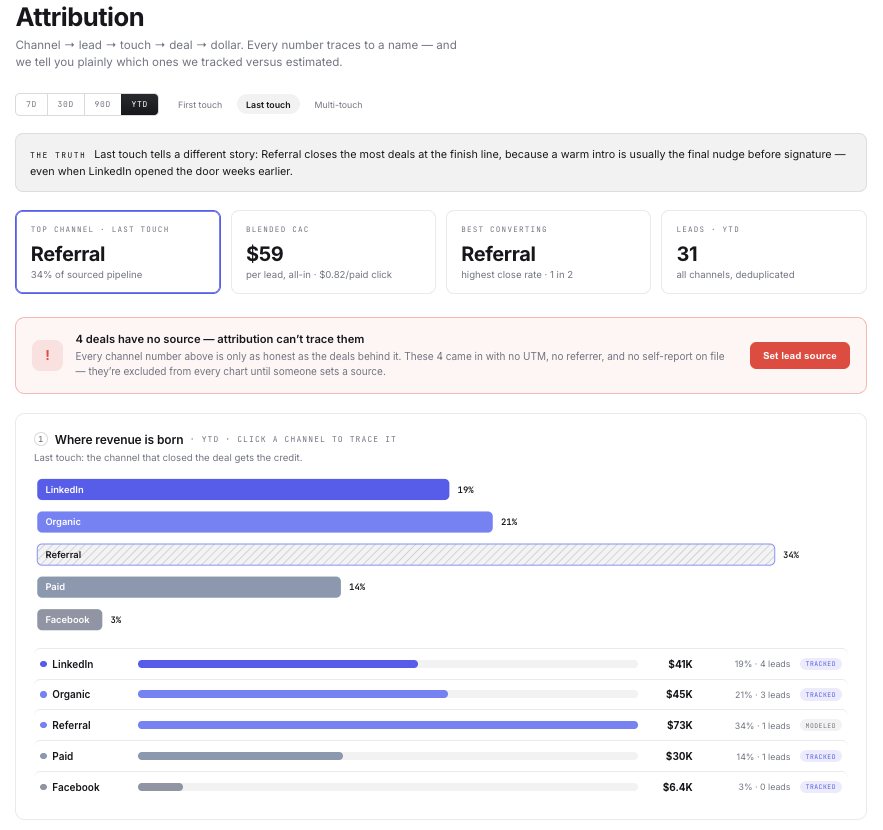
The loop, live: the Paid Ads screen in Atlas. Spend, channel and return reconciled against the CRM, not the platform's own scorecard.
Where we stand
Automate the work. Never the judgment.
We use AI aggressively for research, creative variations and speed. Your brand and your budget never run on autopilot. You approve, the system runs.
Attribution or nothing
If we cannot trace it, we do not spend it
Full-cost ROAS, media plus fees, is the only number we report.
Humans on the wheel
AI drafts and scales. People decide.
Strategy, brand and taste stay human. Your buyers can tell.
No black box
Transparent reporting, not "max" bidding
You always see where the money went and why.
Investment
Ad management, pipeline included.
Every tier includes pixel and conversion tracking setup. The pipeline is never an upsell.
Starter
Single channel
- One platform: Meta, Google or ChatGPT Ads
- Campaign setup and management
- Pixel and conversion tracking install
- Static and carousel creative
- Monthly reporting
- $1K-$5K/mo ad spend recommended
Most popular · Growth
Multi-channel and retargeting
- 3 platforms: Meta, Google and LinkedIn
- Sequential retargeting engine
- Video and static creative production
- CRM attribution wiring
- Bi-weekly strategy calls
- $5K-$20K/mo ad spend recommended
Scale
Full-funnel revenue system
- 5+ platforms, adds YouTube and ChatGPT Ads
- Quiz funnel build with ScoreApp
- Full creative team, 15-30 assets a month
- CRM and revenue attribution
- Weekly strategy calls
- $20K+/mo ad spend recommended
Premium Revenue System
Multi-property B2B, $5M-$50M+
- Dedicated senior team, no junior handoffs
- Multi-brand and multi-region campaigns
- Custom audience modeling and lookalike builds
- Video production studio included
- Full pipeline attribution to closed-won
- $50K+/mo ad spend typical
Digital advertising FAQ
Questions owners ask before they spend.
Why are my ad costs going up?
Generative AI made ad creation nearly free, so everyone is flooding the same feeds. More supply in the auction means the price to reach your buyer keeps climbing. Spending less is not the fix. Knowing exactly which dollar returns is, because that lets you cut the losers and feed the winners every week.
What is the difference between running ads and what you do?
Running ads is turning on a campaign. We build the pipeline the campaign feeds: a pixel on every platform, a funnel built to qualify the click and a retargeting sequence that follows a prospect back until they are ready to talk. The ad earns three seconds of attention. The pipeline turns that into a closed deal weeks later.
What makes Atlas different from an ad agency?
Every campaign runs inside Atlas, the same operating system behind a client's content and attribution. Most agencies are a media buyer with a login. Atlas routes pixel data, creative, budget and retargeting to the right specialist and reports back weekly instead of monthly.
What happens after someone fills out a form or finishes a quiz?
The pixel tags them the instant they convert and they enter a nurture sequence over the next one to two weeks, built on what they told us. They also move into retargeting stage 2, a different ad built for someone who already raised their hand. When engagement crosses a threshold, sales gets a notification to reach out.
Do you advertise on ChatGPT?
Yes. It is our newest channel and we run it on our own campaigns before we sell it. ChatGPT Ads reaches people at the moment they ask an AI which company to call, the same moment our AEO work is built to win organically.
How much should I spend on B2B digital advertising?
A single platform needs $1,000-$5,000 a month in ad spend to optimize. Multi-channel B2B campaigns typically need $5,000-$20,000 a month in spend plus $2,500-$7,500 in management. Established B2B systems run $50,000+ a month in spend. A free ad audit gives you a recommendation built on your numbers.
Why is digital advertising so expensive?
Untracked ad spend is expensive. We report on closed-won deals in your CRM, measured full-cost: ad spend plus our fee against revenue actually closed. Our average client ROAS is 3x, so every $1 of that combined cost returns $3 in tracked revenue.
Do I own my ad account?
Yes, always. If we part ways you keep the data, pixel history, audience lists and creative. We never lock clients into wrapper accounts.
How do you track ad revenue?
Server-side and browser-side conversion tracking (Meta Pixel, Google tag with Enhanced Conversions, LinkedIn Insight Tag, ChatGPT Ads conversion API) wired to your CRM, whether HubSpot, Salesforce, Pipedrive, GoHighLevel or custom. Every closed deal is attributed back to the campaign, ad set and creative that started it, on a live dashboard inside Atlas.
Do you create the ad creative?
Yes. Creative is the targeting now. We script, shoot and edit the video ads plus static, carousel and quiz formats. No stock footage, no template ads. Growth and Scale include 15-30 assets a month.
How long until I see results?
Qualified leads typically show in month 1. The return hits full stride in months 3 to 4, once the platforms have enough conversion data. Sequential retargeting compounds from month 2.
Your move
See what your ad budget should be producing.
We audit your current campaigns, pixels, funnels and retargeting, and show you where the budget is going, traced to closed revenue.