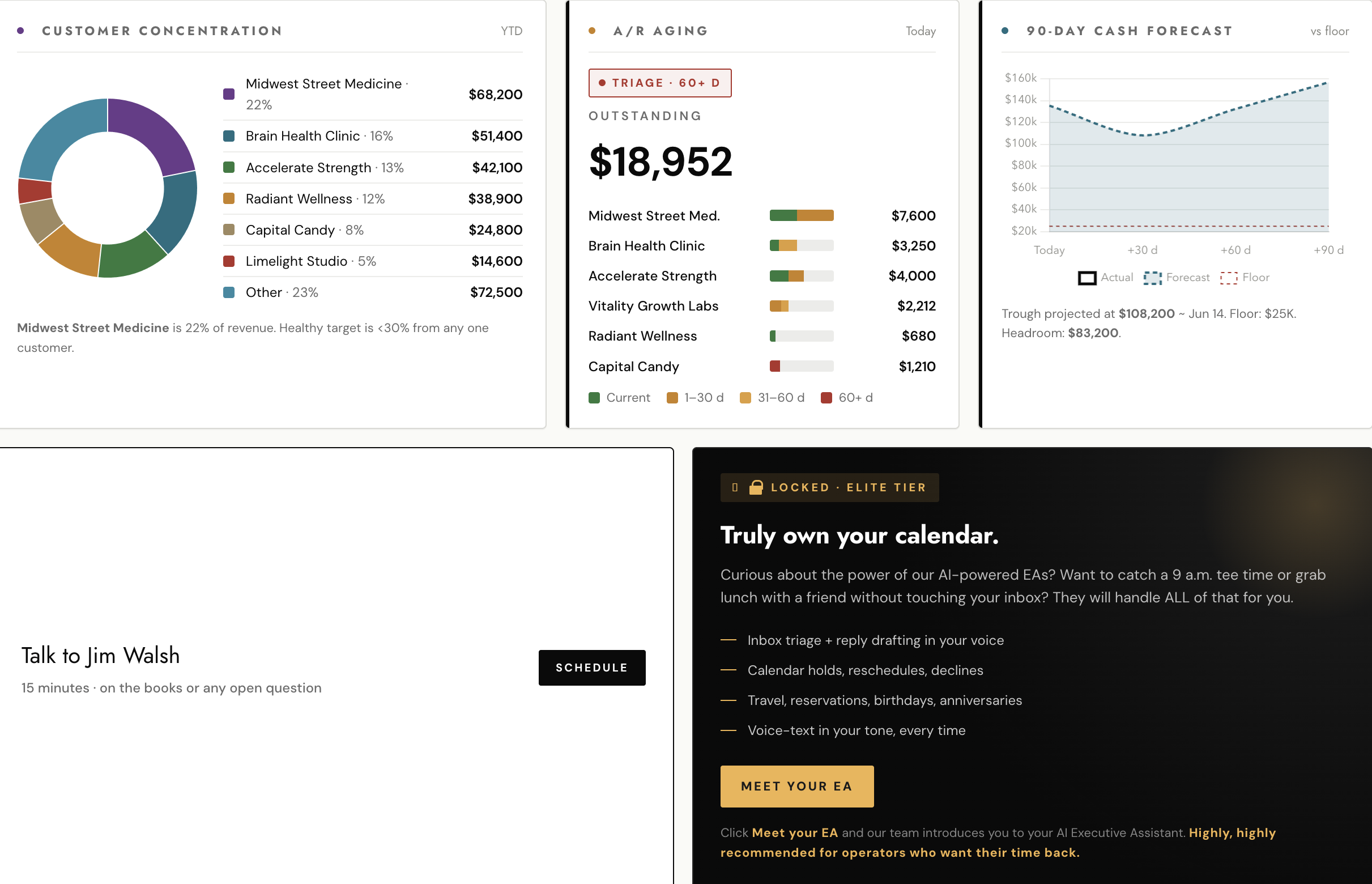
Bolt · Cashflow Cockpit Customer concentration · A/R aging triage · 90-day cash forecast with trough projection
Walsh asked Gravity Growth to give their clients a real-time looking glass into the levers that move cash. We engineered Bolt — a production-grade cashflow intelligence application, informed by primary research with more than nine hundred owner-operators and shipped end-to-end by our product and engineering teams.
I · The Brief
Walsh’s clients are operators. Founders, family-business owners, mid-market CEOs who run high-stakes companies with the same instrument cluster their grandfathers used: a month-end P&L and a chequing balance. By the time variance showed up in a statement, the lever to fix it was already three weeks behind them.
Walsh’s partners had built a reputation on getting in front of those variances earlier than any competing advisor in the region. The constraint was bandwidth. Five partners cannot manually triage cashflow for hundreds of operators without either the partners or the work breaking. The brief Walsh brought to Gravity Growth was direct: build the instrument that lets every client see what a Walsh partner sees, in the same minute the partner sees it.
II · The Research
Before a line of product code was written, Gravity Growth fielded a primary research panel across the upper-Midwest operator economy. The discipline was deliberate: a Fortune-100 development process applied to a small-business problem.
The findings sorted into three structural bottlenecks. They became the three modules Bolt was engineered around.
Sixty-eight percent of respondents could not name their largest customer as a percentage of revenue inside one minute. A material concentration risk — structurally invisible to the operator carrying it.
Seventy-three percent ran aging reports monthly or less. Overdue conversations were postponed by an average of fourteen days — long enough to compound a small problem into a payroll one.
Fewer than one in five had a defensible cash forecast beyond thirty days. The trough — the day the bank balance was at its lowest — was nearly always discovered the week of, not the quarter before.
III · What We Built
Three panels. One pane of glass. Every Walsh client sees the same view their advisor sees, the moment their advisor sees it.
Bolt · Cashflow Cockpit Customer concentration · A/R aging triage · 90-day cash forecast with trough projection
Every customer’s share of YTD revenue, ranked, with the healthy-target threshold drawn directly on the chart. When a client crosses thirty percent on any one customer, Bolt flags it — before the Walsh partner has to.
Outstanding receivables grouped into Current, 1–30, 31–60, and 60+ buckets, with the worst aging surfaced first. The conversation a partner used to start with “let me pull the report” now starts with the answer already on screen.
A continuous cashflow forecast that names the trough — the day the bank balance will be lowest — with the floor and headroom calculated against it. The lever a partner needs to pull is identifiable a quarter in advance, not a fortnight late.
When the data flags a decision an operator should not make alone, Bolt routes directly to Walsh. A fifteen-minute partner consult, booked from the same screen the data is on.
IV · Bolt in Motion
The second module engineered for Walsh: a CFO-grade conversational interface, paired with a workflow that drafts the next action for the operator’s review.

Bolt · Drafted A/R Reminders Ready in Outlook · Send, edit, or skip · Ask Bolt anything about the books
Every overdue invoice generates a reminder, written in the operator’s voice, queued in the mail client they already use. The friction between a Walsh recommendation and an operator action is reduced to a single click — or, when the operator prefers, an edit.
Cash now. Who owes me. Vs. the regional average. June trough. Bolt answers in a sentence, with the variance reasoning a CFO would offer, and the next recommended action explicit. The advisor’s judgement, deployed at the operator’s tempo.
V · The Outcome
“The first time I saw the June trough on my own screen, I had ninety days to do something about it. Until Bolt, I had ninety hours.”
— Walsh client · mid-market operatorBolt is now deployed across Walsh’s client portfolio. The instrument has compressed the partner’s diagnostic loop from a quarterly review cadence to a daily one, without adding partner hours. Operators move on a variance the same day Bolt surfaces it — the lever, by definition, still works.
For Walsh, the product is now a structural moat. For the operator, it is a cockpit. For Gravity Growth, it is the standard our engineering and research teams set when a client’s product is too important to outsource.
Fifteen minutes. On the books, or any open question. The conversation a CFO advisor should have already offered you.
Schedule with Jim →Inbox triage and reply drafting in your voice. Calendar holds, reschedules, and declines. Travel, reservations, birthdays, anniversaries. Voice-text in your tone, every time. Our team introduces you to your EA. Highly recommended for operators who want their time back.
Meet Your EA →Next
Book a Revenue Diagnostic. Thirty minutes. We pull your homepage, your CRM, your cashflow signal, and tell you exactly what to add, fix, or kill in the next ninety days. No proposal deck. No retainer pitch. The diagnostic is the deliverable.