
The AI Operating System Built For Small Business Owners

The Operator's Edge — Issue 01
Written by Steve Schmidt · Founder & CEO, Gravity Growth · Published June 6, 2026
The problem with "AI for business owners" right now
Every agency in America has slapped "AI-powered" on their landing page.
I get pitched two or three "AI growth platforms" a week. Most of them are a ChatGPT wrapper with a dashboard, sold to business owners who already don't have time to learn another tool.
That's not what we built.
We built an operating system. One coordinated team of AI bots that runs the workflows you don't have time for — and surfaces the decisions only you can make.
We call it Atlas.
What Atlas actually does
Atlas isn't a chatbot. It's a Chief of Staff.
Every morning at 6:00 AM, Atlas reads your overnight inbox, your calendar, your CRM, your accounting, and your pipeline. By the time you sit down with your coffee, Atlas has done four things:
1. Triaged your inbox. Real replies drafted in Gmail for the urgent ones. Junk auto-routed. Customer questions answered. You scan, edit, send.
2. Run your standup. Atlas knows what every team member owes you today, who's behind, what's late, what's at risk. The board is current before your first call.
3. Reported financial health. Cash position, AR over 30 days, deals expected to close this week, payroll runway. Pulled from QuickBooks + Stripe + HubSpot — not stitched together by hand.
4. Built tomorrow. Atlas works ahead. Tasks that come due Thursday have drafts ready Tuesday. The board doesn't go red because Atlas backfills before the alarm goes off.
That's day one.
Day one hundred is a different business. Decisions you used to wing at midnight you now make at 9 AM with the data in front of you.
Patterns you couldn't see show up as flags. Hours you used to bleed on copy-paste become hours you spend with customers.
The 7-bot family
Atlas doesn't do it alone. Atlas is the conductor. The work gets done by specialists:
- Atlas — Chief of Staff. Daily Launch Brief, end-of-day Reckoning, growth attribution, accountability.
- BOLT — Real-time cash flow. Cash on hand, 30/60/90 forecast, scenario modeling. Pulls from QuickBooks live.
- Elise — Finance lead. Month-end close. P&L narrative. Tax-prep handoff packets. Risk scoring.
- Frank — EA on steroids. Inbox triage in your voice. Calendar choreography. Never a missed reply.
- Gabby — Lead generation. ICP refinement. Outbound sequences. Reply-rate post-mortems.
- Tyler — Design + growth marketing. Social channels. Brand consistency. Modules and attribution.
- Grace — Content. Long-form. SEO + AEO. The article that ranks AND moves people.
Each one has its own context, its own tools, its own writing voice. They report to Atlas. Atlas reports to you.
The math (the part most owners want)
We built this for a 4-person team running ~$2M ARR. Here's the monthly economic gain we measured on the first deployment:
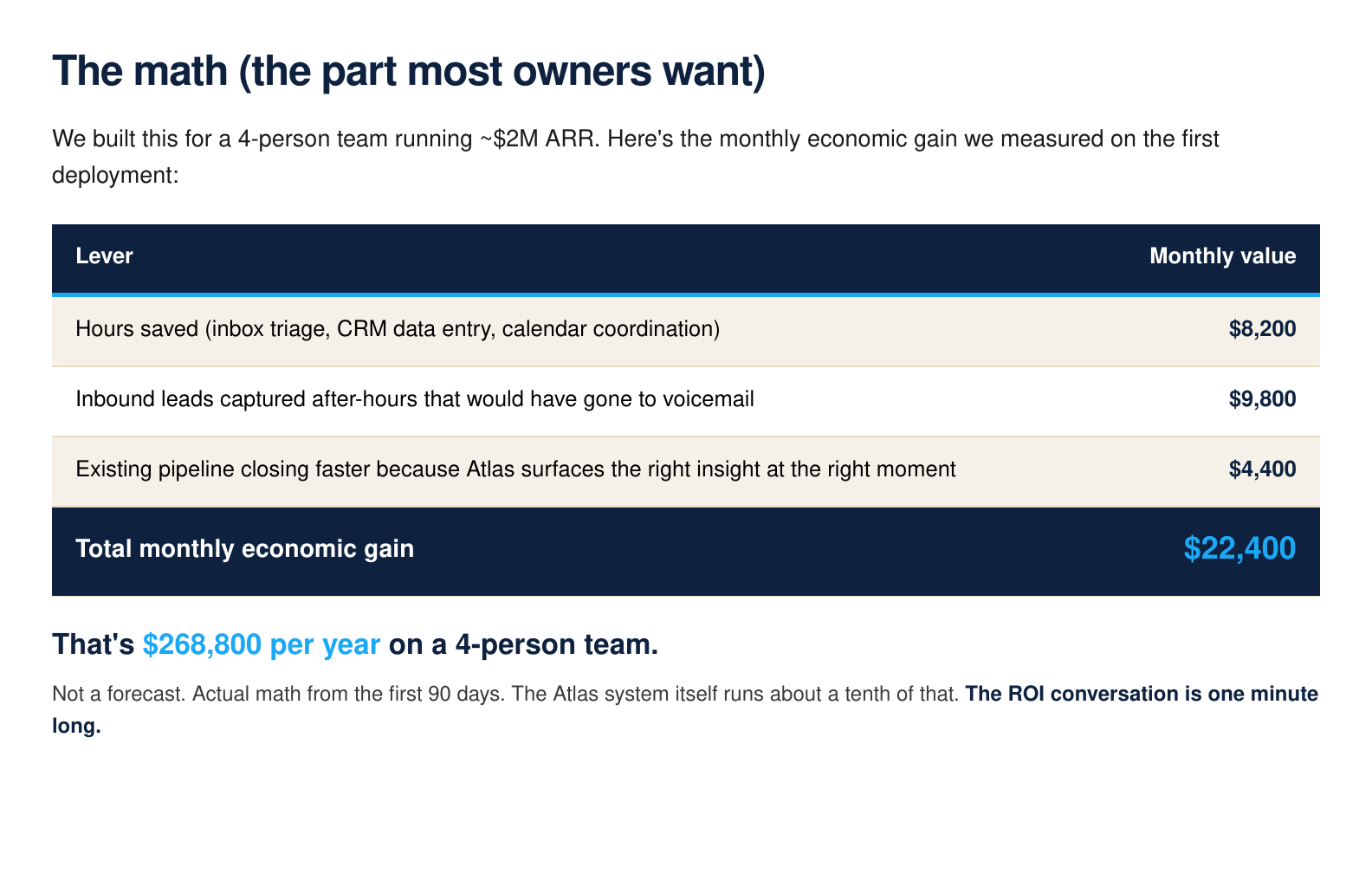
Not a forecast. Actual math from the first 90 days. The Atlas system itself runs about a tenth of that. The ROI conversation is one minute long.
Proof: Walsh × BOLT
Late 2025, the team at Walsh — a multi-property B2B operator doing $5M to $15M in revenue — came to us with a real problem. They didn't know if they were going to make payroll in 60 days. Their books were 3 weeks behind. Their AR aging was a guess. Their cash flow forecast was a spreadsheet that hadn't been opened in a month.
We didn't sell them a dashboard.
We built BOLT: a custom AI CFO app, informed by a 900-business-owner research panel. It pulls live from QuickBooks, layers in scenario modeling, and answers the question every owner asks at 2 AM: can I make payroll next month, and if not, what changes?
Two months in, Walsh had:
- A 30/60/90 cash flow forecast with named risk flags, not vibes
- Three pricing scenarios modeled against their actual customer base, with predicted volume drop per scenario
- Auto-reconciled QuickBooks ↔ Stripe ↔ PayPal — no more 3-week book lag
BOLT is now their CFO cockpit. Their human CFO uses it. Steve, the owner, uses it. The board uses it.
That's what "AI for business" should mean. Not a chatbot. A senior team member that never sleeps and never forgets.
What this means for you (if you're running a $1M–$50M B2B)
Three things you can do this week without buying anything from me:
One. Stop calling it "AI." Call it what it is: a workflow that used to take a person, now done by a tool. Frame every "AI" decision through "what workflow am I retiring, what hours am I getting back, what is that worth?"
Two. Audit your seams. Where does work fall between people? Where does a customer email go unanswered for 18 hours because it landed in the wrong inbox? Where does a lead get scored manually because no one wired the integration? Those seams are where AI pays back fastest. Not where it sounds coolest.
Three. Decide what you'll never automate. For me: the first call with a new customer. The hard conversation with a team member. The decision to fire a client. Pick your three. Everything else is on the table.
What's next
Next week's issue: The standup playbook. How Atlas runs our morning standup across 7 bots, surfaces blockers before they become emergencies, and why the daily operating rhythm matters more than the strategy deck.
If you want to see Atlas live before then, the Meet Atlas page has the full system architecture, the 7-bot roster, the BOLT case study, and the ROI math.
Or just reply to this. I read every one.
— Steve
About this article
The Operator's Edge is a weekly note from inside Gravity Growth — a B2B revenue agency in Sioux Falls, SD. We work with 218+ Midwest operators across web design, SEO + AEO, video, AI automation, and digital ads. One team. One CRM. One attribution layer. $62M+ in revenue traced.
Subscribe · Meet Atlas · Case studies · The Directory on YouTube
