
Understanding the impact of AI on your business
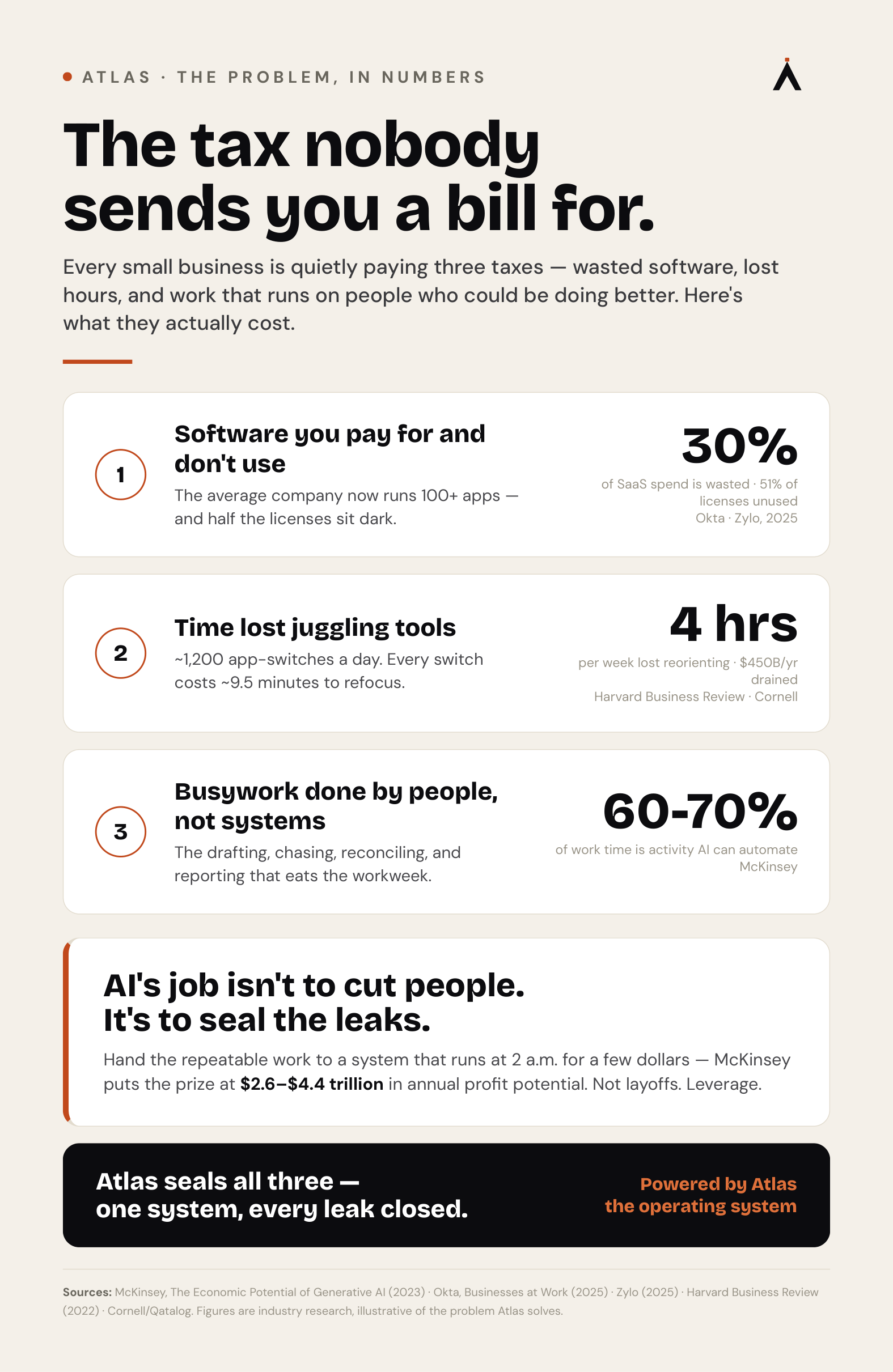
You built a business to be free. Somewhere along the way it made you the bottleneck. The good news: most of what's draining you isn't a people problem — it's three quiet leaks you're already paying for, every single month. Here's where the money actually goes, and how a system seals it without touching your team.
Tax #1 — Software you pay for and don't use
The average company now runs more than 100 SaaS apps (Okta, 2025). Roughly 30% of that spend is wasted, and 51% of licenses sit completely unused (Zylo, 2025).
Picture the 14-person shop paying for nine tools — a CRM, a scheduler, an email platform, two reporting add-ons — three of which nobody's opened since spring. That's not a software budget. It's a subscription to chaos.
Tax #2 — The hours lost holding it together
A Harvard Business Review study found people switch between apps ~1,200 times a day, costing roughly four hours a week per person just to refocus. For a five-person team that's most of a full salaried day, every week, paid in tab-switching.
Tax #3 — Skilled people doing unskilled work
The bookkeeper keying receipts. You, rebuilding the same spreadsheet every Monday. McKinsey estimates today's AI can already automate the activities filling 60–70% of working time. The cost you cut isn't the person — it's the waste of the person.
This doesn't mean cutting staff
You automate the task, not the person. The receptionist who stops doing two hours of reminders takes the calls that need a human voice. Same payroll, more output. And it matters more than convenience: 82% of small-business failures involve poor cash flow (U.S. Bank). You can't fix what you can't see.
Where to start this week
Circle every subscription nobody opened this month — that's your first cut. Then automate the one task eating the most hours that needs the least judgment. You're not rebuilding the business; you're sealing the leaks one at a time.
FAQ
How much can AI actually save a small business?
The savings come from three measured leaks: wasted software (~30% of SaaS spend, per Zylo), hours lost juggling tools (~4 per week per person, per Harvard Business Review), and manual busywork (60-70% of work time is automatable, per McKinsey).
Will using AI mean laying off staff?
It does not have to. You automate the task, not the person - your team gets their hours back for work that needs a human.
What should I automate first?
The single task eating the most hours that needs the least judgment - usually follow-up, reporting, or reconciliation.
What won't AI fix?
A broken offer. AI multiplies whatever you point it at. Fix what you sell and to whom first.
Sources: McKinsey, The Economic Potential of Generative AI (2023) · Okta, Businesses at Work (2025) · Zylo (2025) · Harvard Business Review (2022) · U.S. Bank (via SCORE).
