
You’re Not In The Room
68.01% of US searches now end with nobody clicking. Here's the arithmetic on what that costs a local business — and why a third of the entire shift happened in the last two years.
I did something on camera two weeks ago that I'd been avoiding for months.
Opened ChatGPT. Logged out, so it couldn't flatter me with my own history. Typed eight words.
Best marketing company in Sioux Falls, South Dakota.
We weren't there.
Three firms came back instead. Good ones. All older than us, all of them the same thing they've been for a decade. The machine answered confidently, in a clean paragraph, and our name was not in it.
Here's the part that stings, and it isn't the ranking.
I knew. I'd known for months. I just never typed it, because typing it makes it real, and once it's real you have to do something about it.
I've spent twenty-five years telling owners to face their numbers. I couldn't face eight words about my own company.
A note on the numbers
One source for this whole issue: SparkToro × Similarweb, US Google searches, January–April 2026. Clickstream data, not a survey, not a vendor's own dashboard.
I'm using one source on purpose. Our own AI-search numbers are eight months old and I'm not going to dress up a good quarter as research. Where I do arithmetic on their figures, I show the arithmetic.
Part 1: The decline
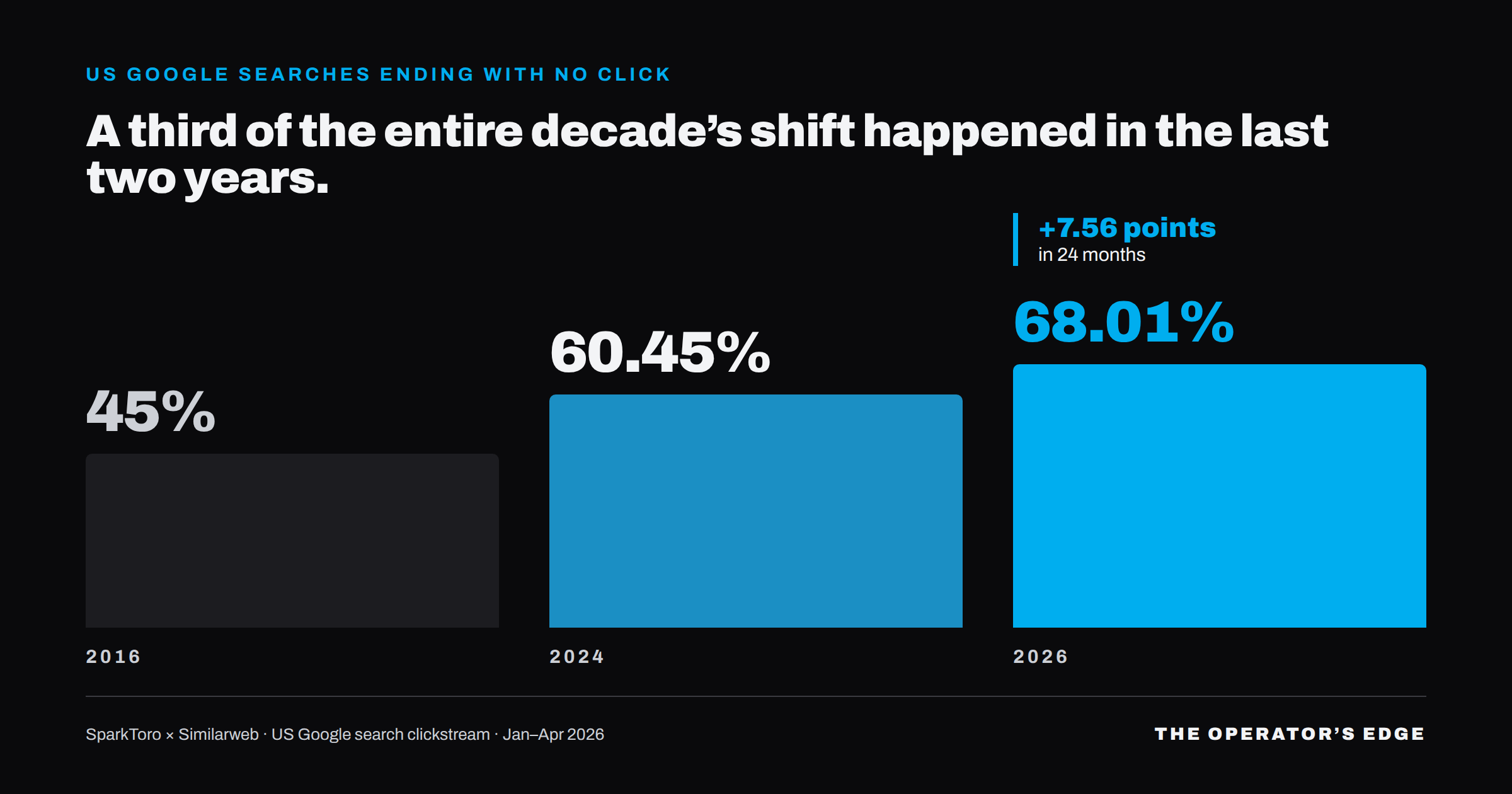
68.01% of US Google searches now end without a single click.
In 2024 it was 60.45%. Ten years ago, roughly 45%.
Run it out.
A third of the entire decade's shift happened in the last two years.
That's not a trend line. That's a cliff with a decade of gentle slope in front of it, and most owners are still budgeting for the slope.
Part 2: What a zero-click search actually costs you
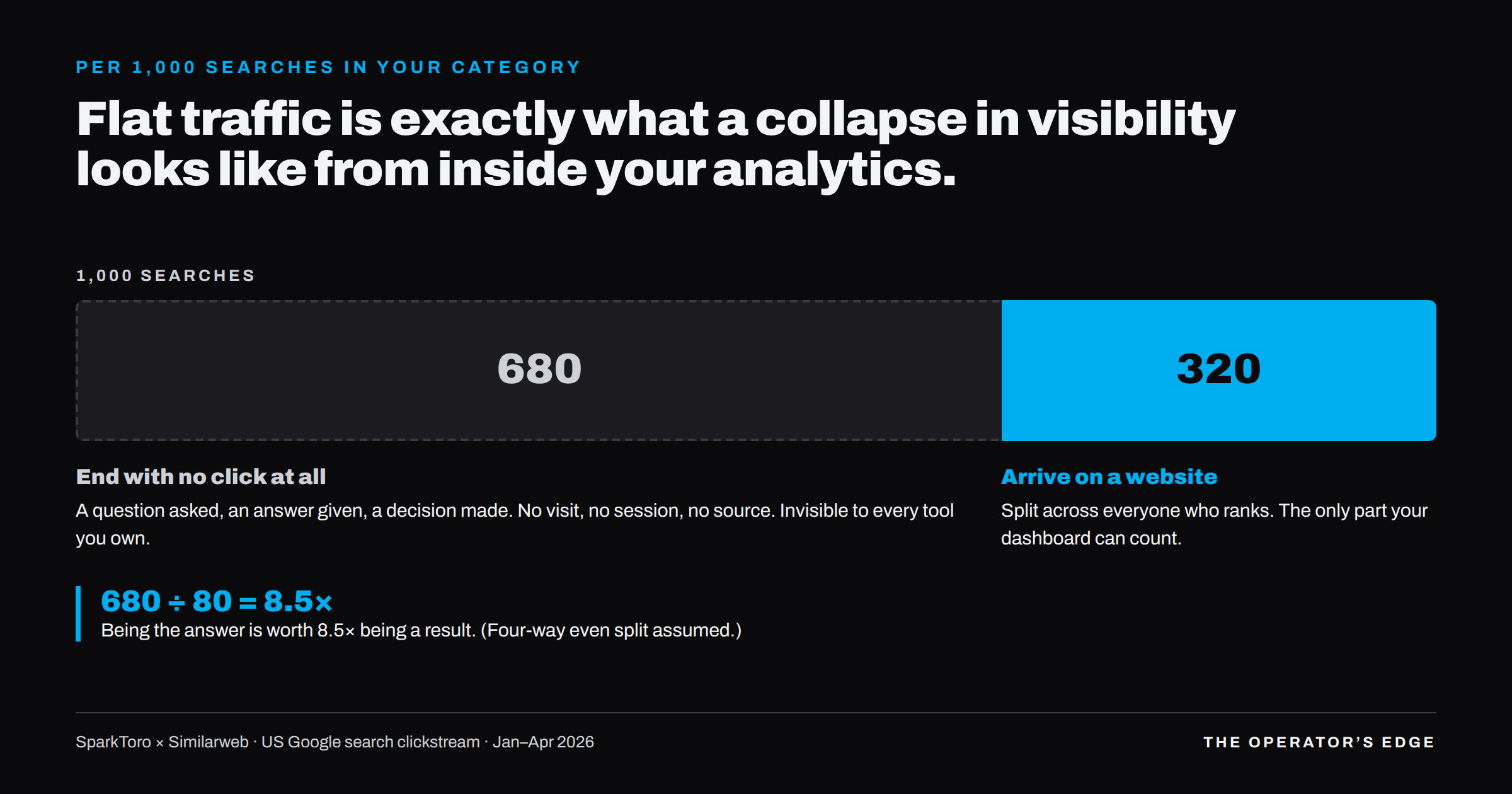
Say your category gets 1,000 searches a month in your market. Round numbers, easy math.
(Even-split assumption is mine, not SparkToro's. Adjust it to however many real competitors you have and the ratio moves, but not the direction.)
Being the answer is worth about 8.5× being a result.
And here's the part that should genuinely bother you: those 680 aren't a lost click. There is no click to lose. Somebody asked a question about exactly what you do, got an answer, and made a decision — and there is no line in your analytics where that happened, because analytics can only count the people who showed up.
Part 3: The flat-traffic trap
Here's the assumption that will cost you the most, and almost every owner holds it:
“My traffic is flat, so nothing's wrong.”
Flat traffic is exactly what a collapse in visibility looks like from inside your analytics. That's not a paradox — it's arithmetic.
Of those 680 no-click searches, not one generates a session. No visit, no bounce, no source, no line item. They are invisible to every tool you own, because every tool you own is built to measure arrivals.
So the 320 clicks keep arriving. Your dashboard holds steady. And underneath it, the share of your category that never reaches anybody's website has grown by 7.56 points in two years — a third of the entire decade's shift — while your reporting showed you a flat line.
You are not looking at evidence that things are fine. You are looking at the only 32% of the market your instruments can see.
The tell isn't in your analytics. It never will be. The tell is what comes back when you type the eight words.
Part 4: Why pivoting makes it worse
When we stopped being a marketing agency and started building our own software, we didn't fade from search. We fell off it.
Here's the mechanism, and it matters to anyone who has ever changed what they sell.
These systems describe you by what you have consistently been — not by what you recently decided to become. Ten years of one story outweighs six months of a new one, every time. The firms ahead of us didn't win on cleverness. They won on not changing.
So there's a stretch after any pivot where you've lost the equity in the old story and haven't built any in the new one, and you are describable as nothing at all.
That's not a branding problem you can write your way out of in a quarter. The answer isn't to pivot back. It's to be relentlessly specific about the new thing, in your own words, everywhere, until the machines catch up.
Part 5: “Near me” is guessing
Same session, I typed “near me.”
It put me in Minneapolis. I'm in Sioux Falls. That's a four-hour drive.
Google spent twenty years getting very good at maps and local intent. These systems haven't. “Near me” is a weak signal to them, so they guess — and they guess toward the bigger metro. The moment I typed the actual city name, the answer changed completely.
If you're local, that gap is both the risk and the opening. Right now a machine may be handing your market to somebody four hours away. It's also why getting specific works so fast, while everyone else is still buying clicks.
Part 6: Proof — three owners, same city
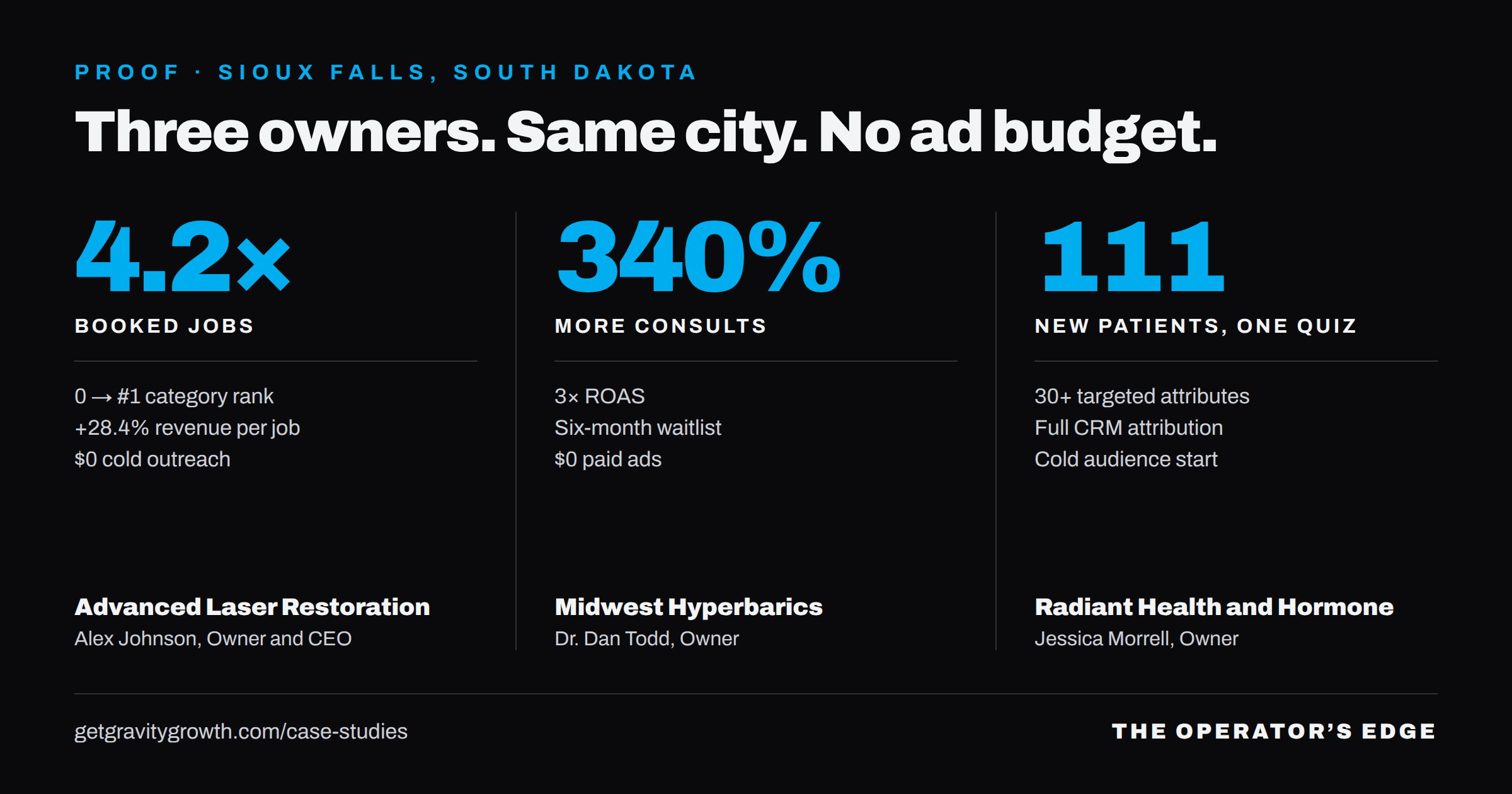
I'm not going to hand you a stat and walk away. Here are three owners in the upper Midwest who ran at this, in their own words and their own numbers. All three are on our site with the receipts.
Advanced Laser Restoration — Alex Johnson, Owner and CEO. Sioux Falls. Home services.
Same city I couldn't find myself in. Restoration is a category where people search in a panic, they search on a phone, and they take the first credible answer. Alex wasn't in that answer. He wasn't ranked low — he was absent, which as we've covered is a different condition entirely.
What changed: not spend. He got specific about what he does and where he does it, in his own words, and then he stayed specific long enough for the machines to believe him. That's the whole intervention, and it's boring, which is why most people won't do it. Consistency reads as authority to a system trained on consistency.
Eight months later: 0 to #1 category rank · 4.2× booked jobs · +28.4% revenue per job · $0 cold outreach
“Now we're the answer when people ask AI who to hire. Same town. Same service. Different system.”
He did not outrank three older, better-funded firms. He got named by the thing people asked instead. Those are different games, and only one of them is still growing.
Midwest Hyperbarics — Dr. Dan Todd, Owner. Sioux Falls. Healthcare.
From invisible to fully booked, on zero paid ads: 340% more consults · 3× ROAS · six-month waitlist
“The video does the work so I don't have to sell myself anymore.”
Read that quote again, because it's the whole thesis in one line. He didn't get better at selling. He stopped having to, because the answer showed up before the conversation did.
Radiant Health and Hormone — Jessica Morrell, Owner. Sioux Falls. Healthcare.
Cold audience to 111 new patients, off one quiz · 30+ targeted attributes · full CRM attribution
“The quiz didn't just give us patients — it gave us a lens into the market. Every answer is a data point.”
That one matters for a reason that isn't the patient count. She didn't just win customers. She found out what her market was actually asking — and in a zero-click world, the question is the only thing you still get to see.
What the three have in common
Same city. Three different categories. No ad budget between them worth mentioning. The variable was specificity held over time — being unmistakably one thing, in your own words, long enough for a machine to repeat it back.
None of them outspent anyone. They just stopped being hard to describe.
Part 7: The six-minute check
Do this today. Logged out, every time — logged in, it's reading your history and telling you what you want to hear.
- Search “best [what you do] near me.” Are you in the answer, or absent?
- Search it again with your city name. Did the answer change? By how much?
- Run both on ChatGPT, Perplexity, Gemini and Google's AI Overview. They disagree more than you'd think.
- Read the description of your business back. Is it accurate, or is it three years old?
- If you pivoted in the last two years — does the answer describe the old thing or the new one?
- Name one competitor who IS in the answer. Ask yourself what they've been consistently saying that you haven't.
If you can't clear four of six, the problem isn't your website. It's that nobody has ever read what the machine says about you.
Where this leaves you
There is a description of your business being read aloud to buyers every day, in a room you are not standing in.
Most owners have never read it. Not because they're lazy — because reading it makes it real.
It took me twenty-five years and a camera crew to run one search I'd been dodging. You can do it in six minutes, alone, and nobody has to watch.
Then you'll know what you're actually working with.
Want the same look without doing it by hand? The Growth Analyzer runs your category across all four platforms and scores what comes back. Takes about ten minutes. I read every result — they're what next week's letter gets built from.
Run the Growth Analyzer →— Steve
Steve Schmidt is CEO and Founder of Atlas, the AI operating system for owners. He spent twenty-five years leading sales teams and now writes about what actually happens when a machine gets to describe your business for you.
SOURCE: SparkToro × Similarweb, US Google search clickstream, January–April 2026. sparktoro.com
