
Atlas Flow · Outsourced SDR, run as a system
Big sales teams have armies. You have Atlas.
Your outsourced SDR without the hire, the agency, or the handoff. Atlas Flow runs outbound lead generation and appointment setting for owner-led companies: every prospect researched individually, every message written around what was actually found, email and LinkedIn worked as one motion, all the way through to a human handoff on the warm reply.
Built for a team you don't have.
Most revenue software assumes a dedicated sales team: SDRs, RevOps, an enablement person, a CRM admin. An owner running a 12-person company has none of that, so the tool turns into 30 hours of setup and a dashboard nobody has time to run. Atlas Flow is built for the owner instead of the seat: small business lead generation without a sales team, and without hiring a cold email agency to send in someone else's voice. Atlas does the outbound. You approve it.
| Hire an SDR | Hire an agency | Buy a tool | Atlas Flow | |
|---|---|---|---|---|
| What you pay | $40–60k salary plus benefits and management (market range) | $5,000–15,000 a month | Seat fees plus your hours | $500–1,500 a month |
| Who writes the message | They do, then they leave | They do, in their voice | You do | You set the voice. The system writes every one. |
| Who owns the relationships | They walk out with them | The agency | You | You |
| Ramp to first meeting | 60–90 days including hiring | 30–45 days | However fast you are | Meetings inside the first weeks |
| Channels | Whatever they will actually do | Usually email only | Whatever you wire up | Email and LinkedIn, coordinated |
| When it stops | You start over | It all goes with them | It sits unused | The system is yours. It keeps running. |
Salary and agency figures are market ranges, not our data. The Atlas Flow range is the published price.
Every option on the left has the same flaw. The thing you are buying leaves: the person, the agency, or your own attention. Atlas Flow stays.
No two prospects get the same email.
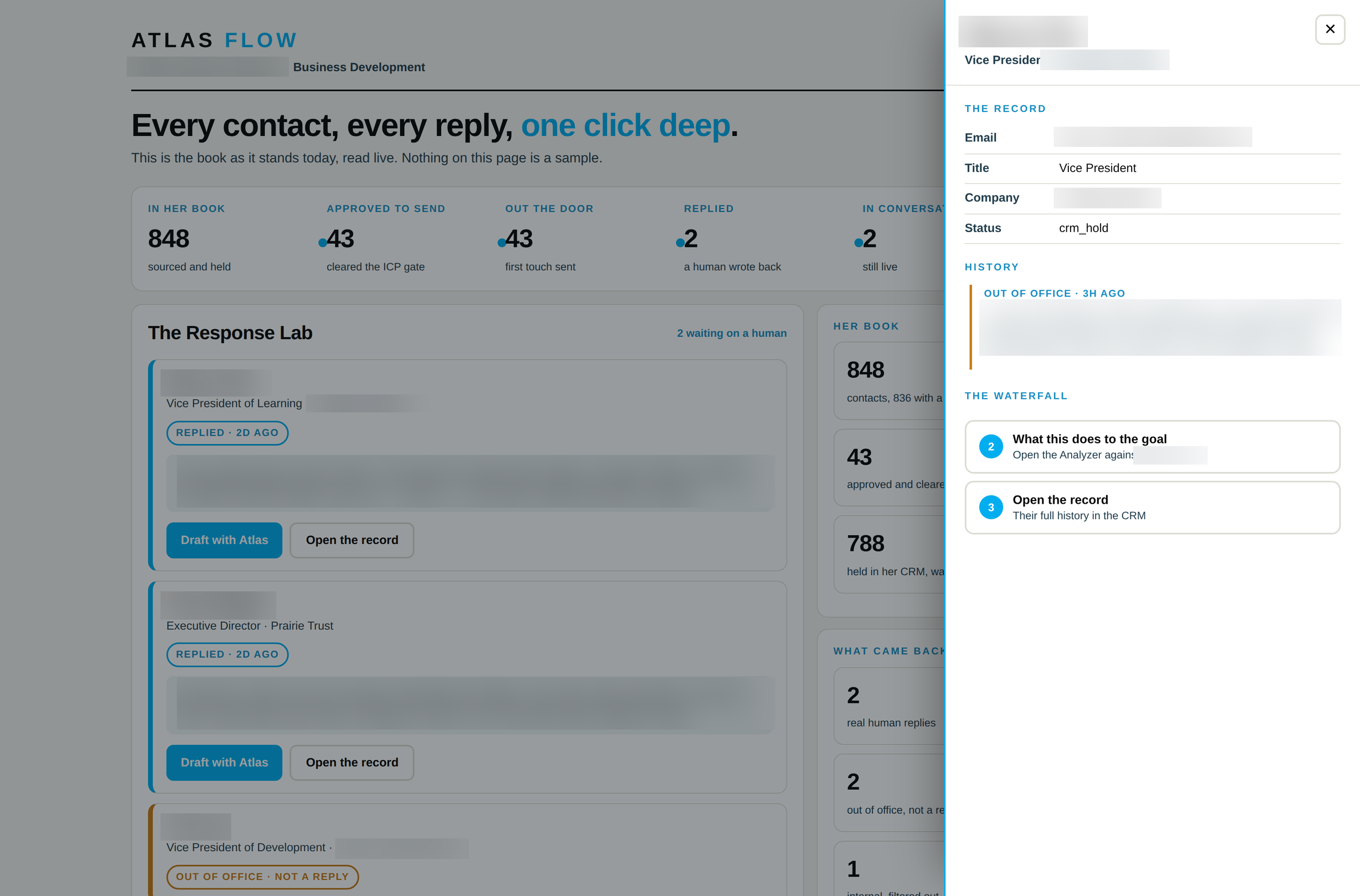
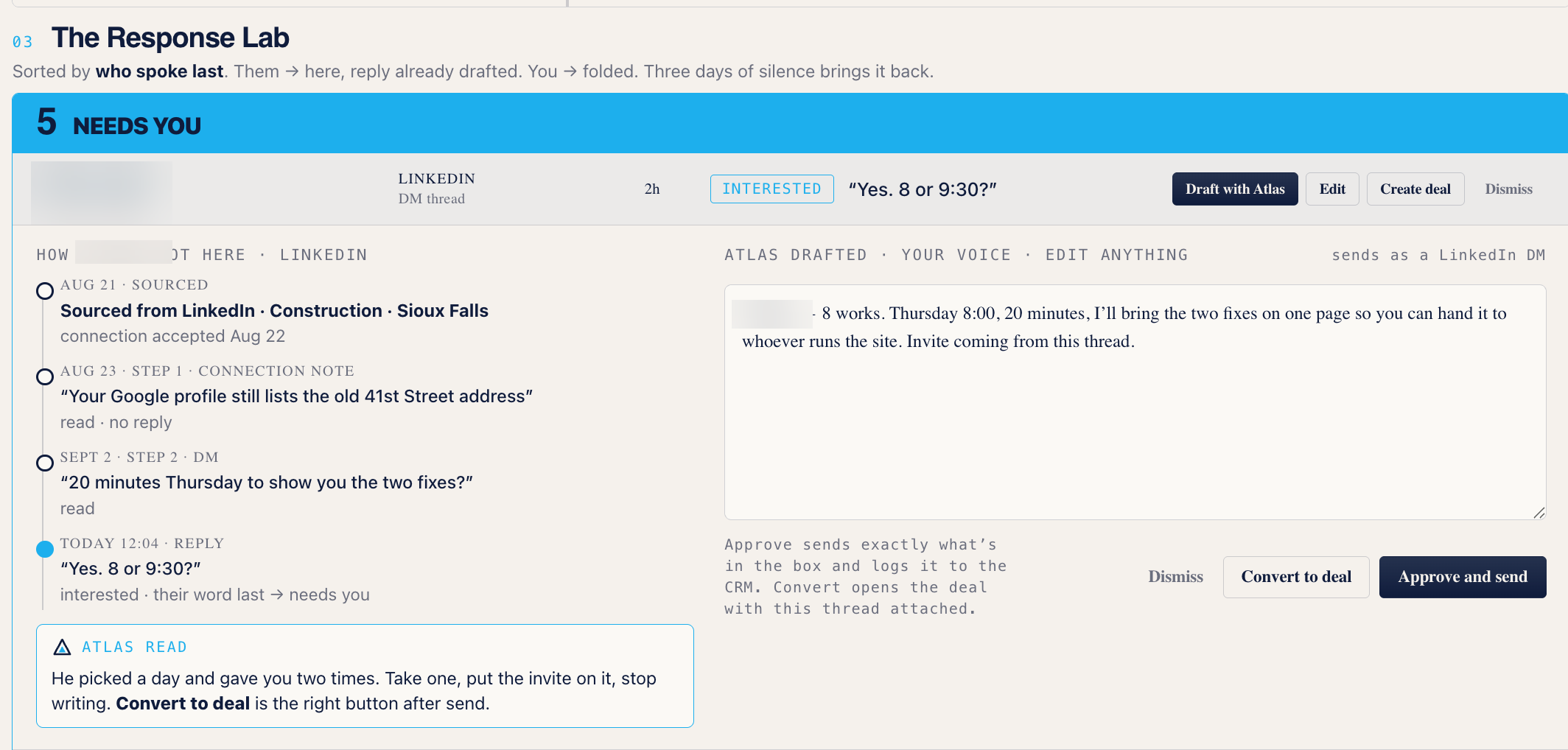
AI email personalization, one to one. Ten to twelve fully researched prospects a day, every day, and that number is deliberately not four hundred. This is what Atlas Flow actually runs on, in your own outbound today.
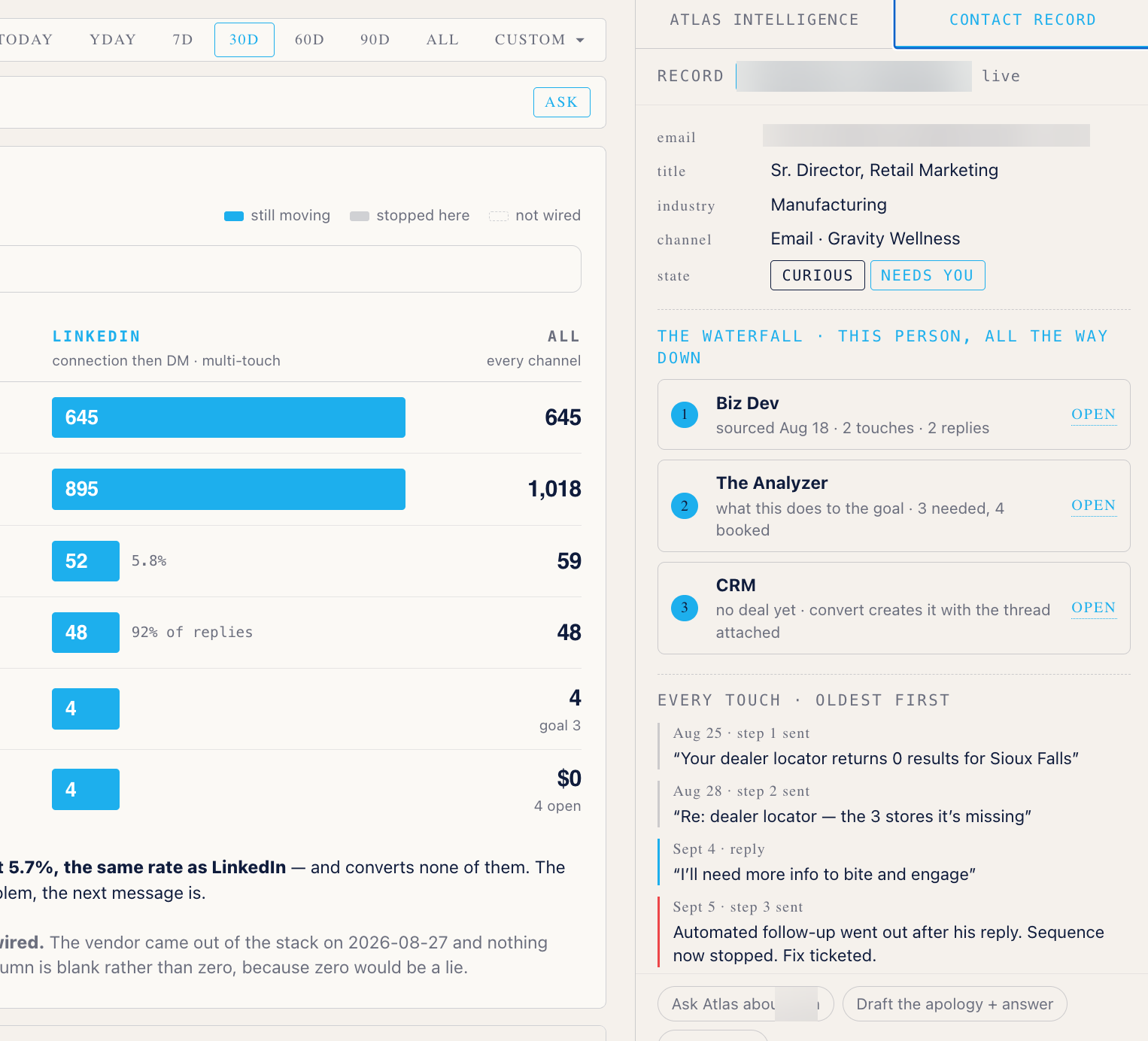
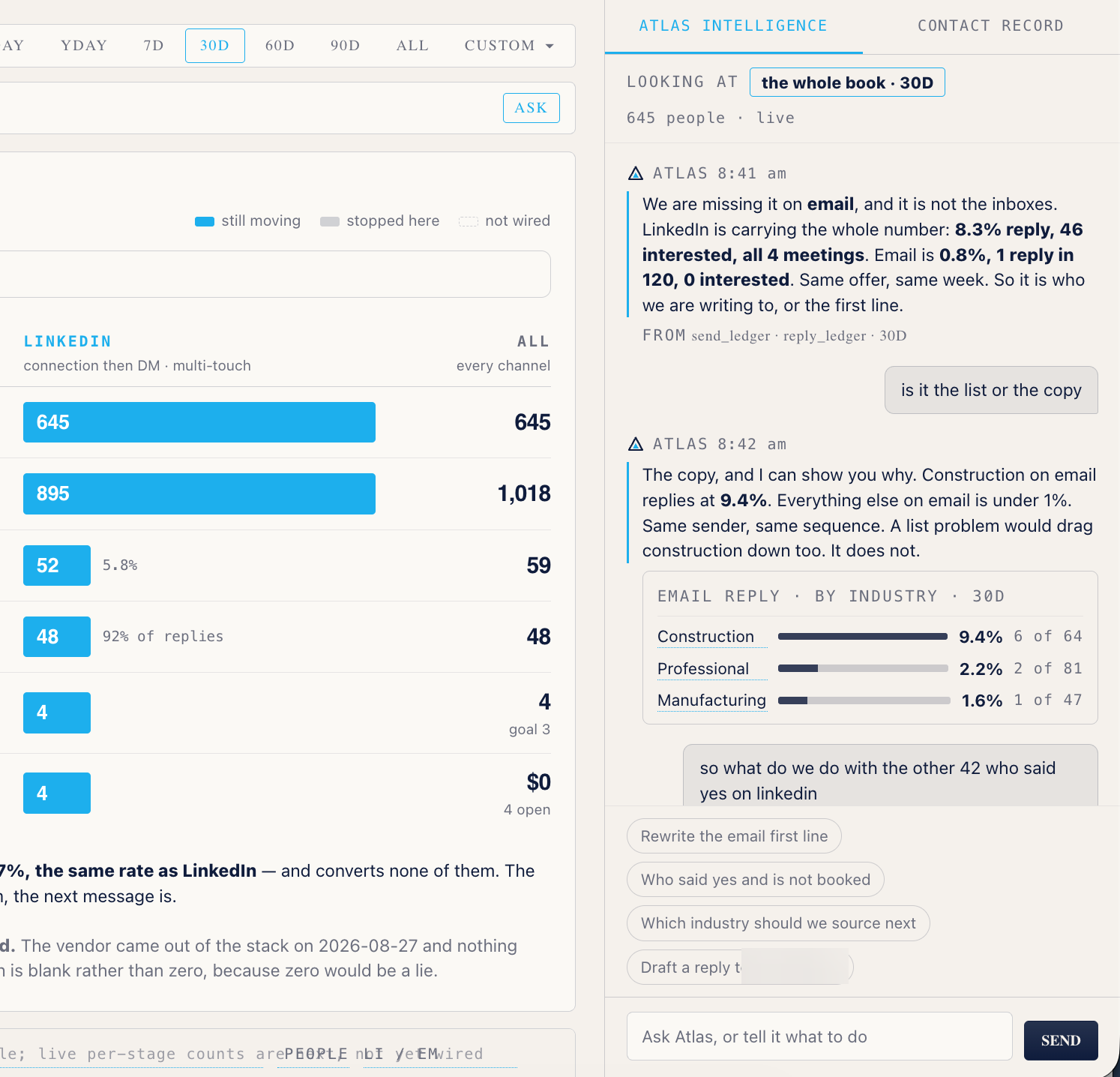
This is not a mockup. This is the live product, running today.
The bar most outbound never clears.
This is the standard every Atlas Flow campaign is held to. Read it honestly against what runs today.
Honest about the number. That is the point.
The goal of a first message is a conversation, not a close.
I ran the agency. I know exactly what was missing.
I built and scaled a sales development agency, grew a company to $5M in under eighteen months, and sold it. I also watched what the model could not fix: message quality collapsed the moment volume went up, the relationships lived with the agency instead of the client, and when the engagement ended the client had nothing to keep.
Atlas Flow is that lesson, built as a system. The research does not degrade at volume because a machine does it. The relationships are yours because the sending identity is yours. And when you stop paying, you keep the thing.
Straight answers on outsourced sales development.
What is an outsourced SDR?
How much does outsourced sales development cost?
Does AI outbound actually work, or does it just get flagged as spam?
Can an AI appointment setter book meetings on its own?
Do I lose control of my messaging?
What happens to the system if I stop paying?
Do you integrate with my CRM?
"We paid an agency before and never got a lead."
That's the correct thought, based on what you've seen. The difference is real-time attribution: what you're spending sits right next to what it's produced, and updates the moment a deal moves. You see it working, or you see exactly why it isn't, the same day.
See what your outbound looks like to Atlas, free.
Your real numbers, no call required.
The Atlas Operating System
You see two.
They run on one.
Atlas Flow and Atlas Creative are what your buyers meet. Both run on Atlas Intelligence. Nothing is bolted on beside anything.